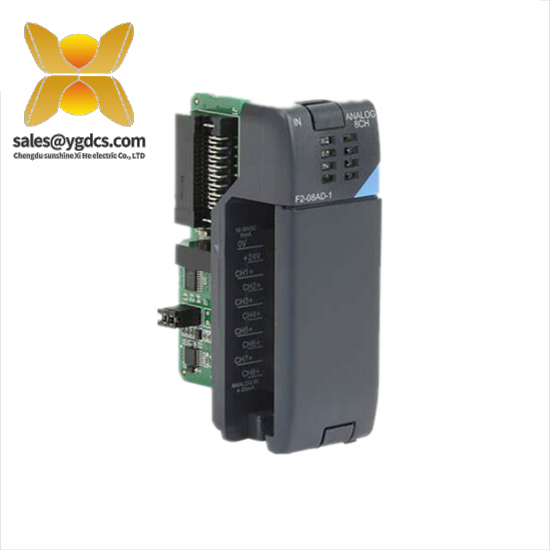
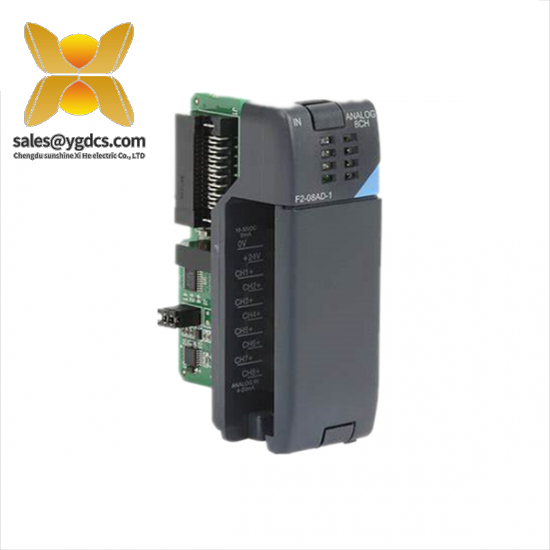


Number of Analog Inputs:8
Sampling Rate:10 kHz
Input Range:-10 V to +10 V
Power Supply Voltage:24 VDC
Operating Temperature:-20°C to +70°C
Enclosure Rating:IP20
Communication Interface:Modbus RTU
The Yokogawa F2-08AD-1 Analog Input Module is a critical component for enhancing precision and reliability in industrial automation systems. Designed for environments with strict temperature constraints (-20°C to +70°C), this module ensures accurate data acquisition under challenging conditions.
With an impressive accuracy of ±0.01% FS ±1 Digit, it delivers unparalleled performance, crucial for industries requiring high-precision measurements such as chemical processing, power generation, and manufacturing. Its versatile input range (0 to 10 V DC, 4 to 20 mA DC) caters to a wide array of sensor outputs, making it adaptable to diverse application scenarios.
Featuring 8 channels, the module supports simultaneous monitoring of multiple parameters, optimizing efficiency and reducing the need for multiple devices. The inclusion of a Modbus RTU interface facilitates seamless integration with existing control systems, ensuring smooth data exchange and process control.
Equipped with a robust 24 V DC power supply, the module ensures reliable operation even in demanding environments. Compact yet durable, with dimensions of 144mm x 90mm x 50mm and a weight of 0.4 kg, it can be easily integrated into various machinery and control panels without compromising space.
Moreover, the Yokogawa F2-08AD-1 Analog Input Module is built with the latest technology, incorporating advanced error correction mechanisms and self-diagnostic features. These enhancements not only improve the overall system reliability but also simplify maintenance, contributing to a lower total cost of ownership.